English
  French


Differentiate or die
This is not your grandfather’s financial services business.
It has never been more apparent that no matter what your position in the sector, you simply can’t mail it in and expect to succeed.
You’ve got to differentiate yourself, your business and your company.
The speed with which technology is moving is picking up and it’s only going to get faster as the potential of artificial intelligence is (somewhat) harnessed.
So, the choice is simple — pick up the pace and stand out or get run over.
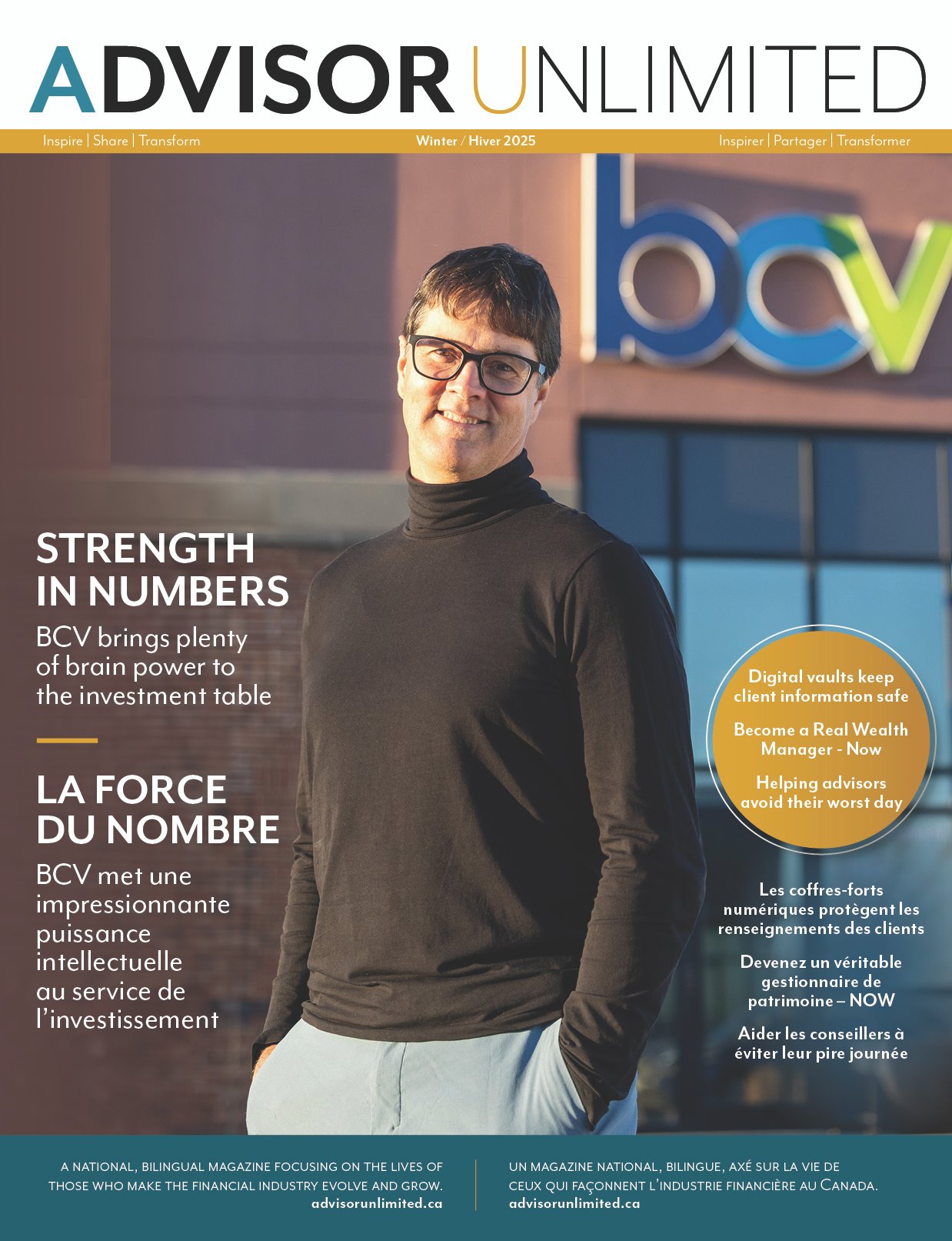
This issue features a whole bunch of differentiators. First, we’ve got BCV Asset Management’s 12-member investment committee, which brings nearly a century-and-a half of experience to the table at its weekly meeting to discuss the companies that make up its more than $6.5 billion in assets under management.
Then there’s Knowledge Bureau offering accreditation for advisors to attain a “Real Wealth Manager” designation. This enables them to be better equipped to deal with the growing number of people at a client’s table, including spouses, children, grandchildren, in-laws and businesses on one side and an accountant, insurance advisor, lawyer, business advisor and doctor on the other.
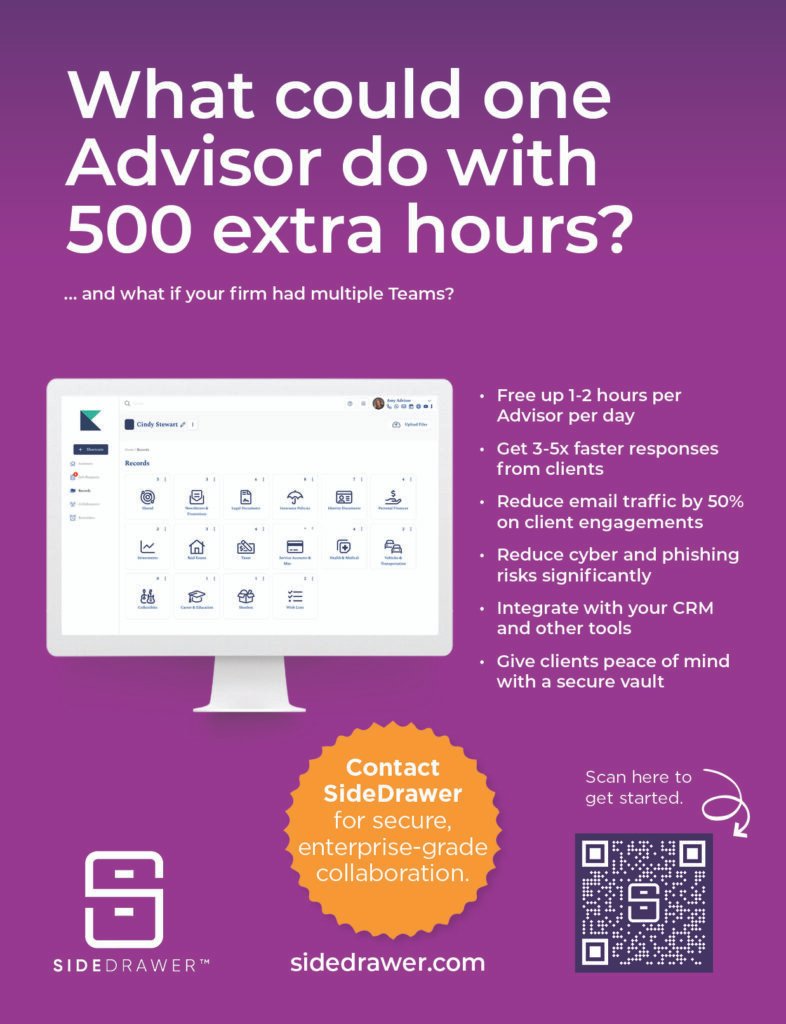
Then there’s SideDrawer, which offers digital vaults, authenticated, policy-driven workspaces for sharing high-value content with clients, staff and partners. They’re used to securely share data and files, complete digital forms, initiate workflows or e-sign documents.
Then there’s The Smith Manoeuvre, which encourages Canadians to turn their biggest debt — their mortgage — into tax-deductible investment debt, helping them simultaneously pay off their house and save more for retirement.
Then there’s Adam Payne at Kinsted Wealth, who started as a lowly research associate in 2013 and then rose up the ranks to become president of the wealth management firm a little over a decade later.
And finally there’s Care Lending Group, which is helping advisors buy new businesses by structuring loans based on cash flow and their ability to service the debt, a strategy that makes them stand out from the banks and other major lenders.



NPC DataGuard helps keep sophisticated hackers at bay.

NPC DataGuard
Larry Keating and his team at NPC DataGuard work hard to help financial advisors across Canada avoid the worst day of their careers.
“Much worse than losing that large client or important product line, having to write a letter advising clients their most private, personal financial information has been lost to criminals is undisputedly the worst,” says Keating, the company’s president and founder. “For the past 15 years I’ve heard from advisors about the impact of breaches by cyber criminals or simply the loss of an unsecured computer. The effect is devastating.”
The ease with which cyber criminals can identify and target vulnerable computer systems today — aided by artificial intelligence (AI) — puts clients’ private information and their money at significant risk. And if that falls into the wrong hands, advisors’ very livelihoods could vanish.
“Our mission is to prevent that from ever happening. We have an excellent track record of doing so. The impact of the loss or penetration of even a single computer on the client, on the advisor, even on our economy, is profound. The more we can defend ourselves, the better off we will all be.”
Three credit health tips to share with clients.

Most people are aware they have a credit score and they know that it impacts them when they apply for a loan. But credit goes beyond borrowing. These three digit numbers could also be used to qualify for home or auto insurance discounts and even determine your client’s career options. If you’re not a lending professional, you probably can’t pull their score. But you can have them access their score and share it, as well as provide these three tips.
1. Check their credit score regularly
A credit score is a three digit number between 300 and 900. Scores in the high 700s and above are generally considered to be excellent.
Your clients can check their credit scores in a few ways.



Smith Manoeuvre
With housing affordability across the country at or near record highs, a mortgage strategy is a crucial element in helping Canadians pay off their biggest expense while simultaneously saving for their retirement.
The vast majority of homeowners take a sequential approach to their financial affairs, paying their mortgage first at the expense of saving for the future because they can only do so much with their limited resources.
That kind of strategy is hardly surprising, says Robinson Smith, president and CEO of Victoria-based Smith Manoeuvre Services Corp.

The end of 2025 is near and for many financial advisors that means a mad rush to close business, sell and hit those often arbitrary targets before the calendar turns. Many advisors continue to be subject to the arcane tradition of annual sales or production grids, where next year’s pay rate is based, as well as other perks and privileges.
These levers of production, used all the way up the corporate ladder, have been in place for so long that they have become an accepted way of doing business. But it doesn’t have to be this
way! The reason why life insurance companies, dealerships, investment firms and banks all use grids is because they work. They work to motivate, through a twisted combination of fear – falling income, losing perks and declining status – and greed – earning more, having a bigger office and being seen as the big dog.


Kinsted Wealth president started on the bottom rung and now leads aggressive growth plans.

President Kinsted Wealth
Adam Payne might have the biggest collection of out-of-date business cards in Canada.
The president of Kinsted Wealth joined the Calgary-based independent wealth management firm in the spring of 2013 as a research associate and almost immediately began his ascent up the corporate ladder. Over the next decade, he would hold seven different job titles.
He didn’t always have his eye on a career in finance as he spent two-and-a half years pursuing a biology degree at the University of Calgary before transferring across campus to the Haskayne School of Business.
One of his courses taught programming, and when Royce Baker, then-president of Kinsted, reached out to his professor looking for somebody who had a high level of knowledge in Excel, his professor recommended Payne. The two met for coffee, hit it off immediately, and Payne joined the company shortly after.

President, Knowledge Bureau
Canada is in the midst of an unprecedented transfer of wealth from the baby boomer generation to their millennial children and grandchildren. As the number of stakeholders in a family’s financial circle grows, the role of their financial advisors has changed. Not only must they keep up with critical issues like tax and estate planning, they must also do so in a new model of wealth planning.
The need to manage potentially millions of dollars in asset values transferring from one generation to the next requires more people around the table than ever before. On the investor’s side, there could be any combination of spouses, children, grandchildren, in laws, and businesses. Don’t forget the community charity partners that could have a stake, too.



CFP® dirk@thefinancialplanners.ca
In an industry defined by change, financial advisors face mounting pressure to deliver personalized advice faster and more efficiently. Yet many find themselves limited by time, tools or training. Whether it’s struggling to build comprehensive plans, underusing planning software or simply feeling overwhelmed, these challenges are common and solvable.
The truth is simple: advisors don’t need to do more — they simply need to take control.
Dirk’s Hands-On Approach
I believe every advisor can excel at financial planning when given the right tools, structure and support. My approach is hands-on and personalized. I start by understanding how each advisor works, including how they connect with clients, present strategies and deliver value.

Nineteen heads are better than one, particularly when they’ve got more than 150 years of combined experience in making great investments.
When the primary investment committee at BCV Asset Management convenes for its regular Thursday meeting either online or in its Winnipeg boardroom, its 19 members have left virtually no investment stone unturned. They each share their research notes with the goal of generating the best ideas that could be implemented into BCV’s North American Equity Fund, which has $465 million in assets under management (AUM) as of Sept. 30.
That research is focused on fundamental analysis of individual companies and their sectors as well as an understanding of the different macroeconomic factors that will play a role – ideally looking for dividend paying, industry-leading companies with a global footprint.
“Our investment committee leverages the experience and understanding of our members to bring the most brain power to assess an idea,” says Todd Johnson, portfolio manager and BCV’s chief investment officer.


Vice-President, Wealth Distribution at HomeEquity Bank
For Canadians 55+, wealth looks different today than it did a generation ago. The family home is not only a place of comfort and independence but it’s also the single largest financial asset for many households. With $2.5 trillion in home equity held by this demographic, it’s impossible to ignore the role that property plays in long-term planning.
At the same time, priorities are shifting. More clients want to help their children get into the housing market or fund their grandchildren’s education. Longer life expectancies and record home values add further complexity. For advisors, this creates a new challenge – how to help clients preserve their investments while also giving them the flexibility to use their wealth with purpose.
“Advisors often tell us they don’t have clients who need this,” says Jeff Thorsteinson, vice-president, wealth distribution at HomeEquity Bank. “That’s where the opportunity starts. The conversation has moved well beyond need – it’s about enabling clients to act on opportunities, preserve their investments and use their wealth more strategically.”

SideDrawer
As the need to share sensitive files continues to grow while artificial intelligence is simultaneously turning weekend hackers into international criminal masterminds, an increasing number of financial services companies are turning to digital vaults to boost their security with client transactions.
You can’t store traditional valuable items in digital vaults but they are authenticated, policy-driven workspaces for sharing high-value content with clients, staff and partners. They’re used to securely share data and files, complete digital forms, initiate workflows or e-sign documents.



CEO, CMI Financial Group
No matter what curve balls are being thrown by the Canadian housing market, Bryan Jaskolka remains focused on helping consumers who don’t qualify for a traditional mortgage access financing.
The CEO of CMI Financial Group doesn’t feel the need to overcomplicate matters.
“This is your neighbour’s mortgage,” he says.
Jaskolka believes that catering to consumers who have “fallen out of the banking channel” provides a critical underpinning to the Canadian economy and its housing market.



Senior vice-president, head of Aviso Correspondent Partners
In a financial world that often prioritizes speed over substance, one company operating in a niche area stands apart because of its more deliberate, thoughtful approach.
Aviso Correspondent Partners (ACP) is a key player in Canada’s correspondent and institutional space. Operating behind the scenes, ACP provides critical services to hundreds of financial institutions and thousands of advisors. These services include executing a high volume of transactions and trades, ensuring safe custody for billions in client assets, and handling essential back-office functions, like recordkeeping and statement production. Their clients range from portfolio managers and investment dealers to foundations, trusts and non profits.